

In an era where data-driven decisions separate successful organizations from failed ventures, determining source reliability has become a critical competency for business professionals. Data USA, a comprehensive public data visualization platform developed through collaboration between Deloitte, Datawheel, and MIT Media Lab, aggregates information from official U.S. government sources including the Census Bureau, Bureau of Labor Statistics, and Bureau of Economic Analysis. However, its reliability depends on understanding what the platform actually delivers: highly accessible visualizations of government data, not original research or proprietary analytics.
The credibility question matters because flawed data sources cost organizations an estimated $15 million annually in poor strategic decisions. For business professionals conducting market research, economic and policy analysis, or feasibility studies, Data USA offers significant advantages through its integration of multiple official datasets and sophisticated visualization tools. Yet limitations exist in data freshness, granularity for specific use cases, and contextual interpretation that sophisticated analysis requires.
This evaluation examines Data USA’s reliability through systematic criteria: source transparency, data accuracy, update frequency, methodological rigor, and practical application boundaries. By understanding both the platform’s strengths as a secondary data aggregator and its inherent constraints, decision-makers can determine precisely when Data USA serves as an appropriate resource and when alternative or supplementary sources become necessary. The assessment provides actionable guidance for professionals who require dependable information without compromising analytical standards.
What Is Data USA and How Does It Work?
Data USA is a comprehensive public data visualization platform launched in 2015 through a collaborative partnership between Deloitte, a global professional services firm, and Datawheel, a data visualization company based in Massachusetts. The platform was developed with a clear mission: to democratize access to government data by making complex statistical information accessible and understandable to the general public, researchers, and business professionals.
The platform aggregates data from multiple authoritative government sources, primarily drawing from the U.S. Census Bureau, the Bureau of Labor Statistics (BLS), and the Bureau of Economic Analysis. Additional data comes from the National Center for Education Statistics, the FBI’s Uniform Crime Reporting program, and various other federal agencies. This multi-source approach allows Data USA to present a comprehensive view of geographic regions, industries, occupations, and educational institutions across the United States.
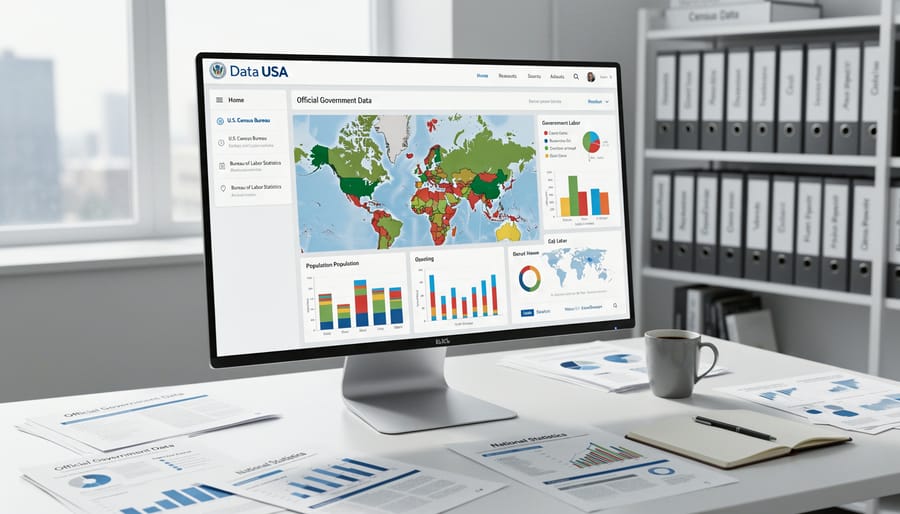
What distinguishes Data USA from traditional government data portals is its emphasis on visualization and user accessibility. Rather than requiring users to navigate complex spreadsheets or understand statistical methodologies, the platform transforms raw datasets into interactive charts, maps, and infographics. Users can explore economic indicators, demographic trends, employment statistics, and educational outcomes through an intuitive interface that requires no specialized technical knowledge.
The platform operates on an open-access model, making all visualizations and underlying data freely available without subscription fees or registration requirements. This commitment to transparency extends to its methodology, as Data USA provides documentation about data sources and collection methods for each visualization.
The technical infrastructure supporting Data USA employs advanced data processing systems that regularly update information as new government datasets become available. This automated approach ensures that users access current information while maintaining consistency in how data is presented across different geographic levels, from national overviews to county-specific profiles.

Evaluating Data USA’s Reliability: Key Criteria
Data Provenance and Source Credibility
Data USA’s credibility stems primarily from its systematic aggregation of information from authoritative federal agencies. The platform draws its datasets exclusively from official government sources, including the U.S. Census Bureau, Bureau of Labor Statistics, Bureau of Economic Analysis, and similar institutions. This foundation provides a significant advantage in terms of authenticity, as these agencies follow rigorous collection methodologies, statistical standards, and quality control protocols mandated by federal regulations.
The reliance on government sources means Data USA inherits both the strengths and limitations of these institutions. Federal agencies employ professional statisticians, use probability-based sampling techniques, and maintain transparent documentation of their methodologies. Data undergoes multiple validation stages before publication, and agencies regularly publish margins of error and confidence intervals. This systematic approach to data collection and verification substantially reduces the risk of manipulation or fabrication.
However, users should recognize that government data accuracy depends on several factors. Response rates in surveys can affect representativeness, and there may be temporal delays between data collection and publication. Additionally, different agencies may use varying definitions for similar concepts, which Data USA must reconcile when integrating datasets. The platform’s visualization tools do not alter underlying data values, serving instead as an interface layer that makes government statistics more accessible to non-technical audiences.
For business professionals and market analysts, this provenance model offers reliable foundation data, particularly for demographic trends, economic indicators, and employment statistics that inform strategic planning and market analysis.
Transparency in Methodology
Data USA demonstrates a commendable commitment to methodological transparency, providing users with substantive documentation regarding its data collection and processing procedures. The platform clearly identifies its primary data sources, which include the U.S. Census Bureau, Bureau of Labor Statistics, and other federal agencies, establishing a traceable chain of custody for the information presented. Each visualization includes source attribution, allowing users to verify the provenance of specific datasets.
The platform’s technical infrastructure, built on the Deloitte-developed Data Driven Documents system, employs advanced data processing algorithms to aggregate and standardize information from disparate government databases. Documentation regarding these processing methods is available through the platform’s public GitHub repository, offering technical users insight into transformation protocols and computational approaches.
Metadata accessibility varies depending on the dataset in question. While primary statistics include temporal parameters, geographic scope, and measurement units, more granular details about sampling methodologies, margin of error calculations, and data collection limitations often require navigation to the original source agencies. This approach reflects industry standards but may require additional research for users conducting rigorous analytical work.
The platform provides a public API with comprehensive documentation, facilitating programmatic access for business analysts and researchers requiring bulk data extraction. This technical transparency enables independent verification and integration with proprietary analytical systems. However, the documentation assumes baseline familiarity with government statistical frameworks, potentially creating accessibility challenges for users without prior experience navigating federal datasets. Overall, Data USA maintains transparency standards appropriate for professional decision-making contexts while acknowledging that complete methodological understanding may require consulting primary source documentation.
Strengths of Data USA for Business Applications
Data USA offers several compelling advantages for business professionals seeking reliable demographic and economic intelligence. The platform’s comprehensive geographic coverage stands out as a primary strength, providing data at national, state, metropolitan, county, and even zip code levels. This granular approach enables organizations to conduct precise market analysis and location-based research, whether evaluating expansion opportunities or understanding regional consumer demographics.
The platform’s accessibility represents another significant advantage. Unlike proprietary data services that require substantial financial investment, Data USA provides free access to extensive datasets drawn from authoritative government sources. This democratization of data allows businesses of all sizes to access the same quality information previously available only to organizations with large research budgets, leveling the competitive landscape for data-driven strategic decisions.
Data USA’s visualization tools deliver considerable value through their user-friendly interface. Complex statistical information transforms into interactive charts, maps, and graphs that facilitate quick comprehension without requiring advanced statistical expertise. Business analysts can rapidly identify trends, compare regions, and extract actionable insights without extensive data manipulation or specialized software. The platform’s integration of multiple authoritative data streams, including the Census Bureau, Bureau of Labor Statistics, and other federal agencies, creates a unified analytical environment that would otherwise require consulting numerous separate sources.
- Completely free access to comprehensive government datasets eliminates cost barriers for businesses
- Interactive visualization tools simplify complex data interpretation for non-technical users
- Multi-level geographic coverage supports both macro and micro-level market analysis
- Integration of diverse data sources provides holistic demographic and economic perspectives
- Data updates follow government release schedules, which may lag behind real-time market conditions
- Limited customization options compared to specialized business intelligence platforms
- Cannot incorporate proprietary or industry-specific datasets alongside public information
- Historical data depth varies across different metrics and geographic levels
The platform’s technical architecture also merits recognition. Built on modern data infrastructure, Data USA employs responsive design that functions effectively across devices, enabling field research and mobile accessibility. The standardized data formats and consistent interface reduce the learning curve for new users while maintaining analytical depth for experienced researchers conducting sophisticated comparative analysis.
Limitations and Considerations for Corporate Use
While Data USA provides substantial value as a publicly accessible data visualization platform, corporate users must recognize several important limitations that may affect its utility for business-critical decisions.
The most significant constraint involves data lag times. Government agencies typically release statistical information months or even years after collection, meaning Data USA’s datasets may not reflect current market conditions. For industries experiencing rapid transformation or organizations requiring real-time intelligence, this temporal gap can substantially diminish the platform’s relevance. Corporate planning cycles often demand the most recent data available, and relying on information that is 12 to 18 months old may lead to outdated strategic assumptions.
Granularity limitations present another critical consideration. While Data USA aggregates information at national, state, and county levels, many corporate applications require neighborhood-level insights, specific demographic segments, or industry classifications beyond standard NAICS codes. Companies conducting site selection analysis, franchise expansion planning, or hyper-local marketing campaigns will find the geographic and categorical resolution insufficient for their precision requirements. The platform’s aggregated nature, while excellent for broad trends, cannot substitute for specialized market research when granular detail determines success.
Perhaps most importantly, Data USA lacks proprietary competitive intelligence. The platform contains no information about private company performance, consumer sentiment surveys, brand awareness metrics, or emerging market signals that commercial data providers offer. Businesses evaluating competitive positioning, assessing market share opportunities, or tracking industry-specific KPIs will find significant gaps in the available information.
The absence of forward-looking projections further limits strategic planning applications. Data USA presents historical facts without predictive modeling, forecasting, or trend analysis tools that corporate decision-makers typically require. Organizations developing multi-year business plans need projected demographic shifts, economic forecasts, and anticipated regulatory changes that extend beyond retrospective data.
Consequently, Data USA functions most effectively as a foundational reference layer rather than a comprehensive business intelligence solution. Corporate users should view it as a starting point for market research, suitable for validating basic assumptions and identifying broad patterns, but recognize the necessity of supplementary sources. Combining Data USA with commercial databases, industry reports, primary research, and real-time analytics platforms creates a more robust information ecosystem that addresses the platform’s inherent constraints while leveraging its strengths as a reliable government data aggregator.
How Data USA Compares to Commercial Market Research Platforms
Data USA operates within a fundamentally different framework compared to commercial market research platforms, each serving distinct purposes for business intelligence needs. Understanding these differences helps organizations determine which resource best aligns with their analytical requirements.
| Feature | Data USA | Commercial Platforms |
|---|---|---|
| Cost | Free, publicly accessible | Subscription-based, often substantial investment |
| Data Freshness | Updated annually or less frequently | Real-time to quarterly updates available |
| Customization | Limited to available datasets | Highly customizable research options |
| Industry Specificity | Broad economic and demographic data | Deep industry vertical analysis |
| Analysis Depth | Descriptive statistics and trends | Predictive modeling and competitive intelligence |
Commercial platforms like Nielsen, IBISWorld, or Gartner deliver proprietary research, competitive intelligence, and predictive analytics that justify their premium pricing for organizations requiring granular market insights. These services excel in providing current consumer behavior data, competitive landscape analysis, and forward-looking forecasts essential for strategic planning.
Data USA provides exceptional value for foundational research, baseline demographic analysis, and policy analysis where official government statistics serve as authoritative references. Organizations conducting preliminary market assessments, academic research, or community development initiatives benefit significantly from the platform’s comprehensive, zero-cost access to verified federal data.
The timeliness factor represents a critical distinction. Commercial platforms often aggregate data from multiple sources including proprietary surveys, delivering insights within weeks of market shifts. Data USA relies on federal reporting cycles, meaning certain datasets may lag behind current conditions by one to two years, limiting applicability for time-sensitive business decisions.
For optimal results, many organizations adopt a hybrid approach: utilizing Data USA for demographic foundations and macroeconomic context while supplementing with commercial platforms for industry-specific intelligence and competitive positioning. This combination leverages the reliability and cost-effectiveness of public data alongside the depth and currency of commercial research services.
Best Practices for Using Data USA in Strategic Decision-Making
To maximize the strategic value of Data USA while maintaining analytical rigor, organizations should implement a structured approach that recognizes both the platform’s capabilities and its limitations. Begin by using Data USA as a foundational resource for preliminary research and trend identification rather than as a sole data source. The platform excels at providing broad demographic, economic, and industry overviews that can inform initial hypotheses and guide deeper investigation.
Implement a validation framework by cross-referencing Data USA findings with primary sources. Since the platform aggregates data from government agencies, verify critical statistics by consulting the original datasets from the U.S. Census Bureau, Bureau of Labor Statistics, or other authoritative sources. This dual-verification approach ensures accuracy while leveraging Data USA’s user-friendly interface for efficient data discovery.
Complement Data USA with proprietary research and comprehensive market intelligence platforms that offer real-time insights, competitive analysis, and forward-looking indicators. Data USA’s reliance on government data means information may lag current market conditions by several months or years, making it less suitable for time-sensitive decisions or rapidly evolving sectors.
Apply contextual judgment when interpreting visualizations and aggregated statistics. Government data collection methodologies may not align perfectly with specific business definitions or market segments, requiring careful consideration of how metrics are defined and measured.
Reserve Data USA for strategic applications where macro-level trends matter most: market sizing, demographic analysis, regional economic assessments, and workforce planning. Avoid relying on it exclusively for tactical decisions requiring granular, real-time data or proprietary competitive intelligence. Document your data sources and validation methods to maintain transparency in decision-making processes and establish audit trails for future reference.

Data USA serves as a reliable source for foundational demographic and economic data, particularly when users require accessible visualizations of government statistics. The platform’s credibility stems from its use of authoritative datasets including Census Bureau information, Bureau of Labor Statistics reports, and other federal sources. However, its reliability must be understood within appropriate boundaries. For strategic business decisions, Data USA functions best as a starting point rather than a sole information source. The platform excels at providing high-level market overviews and identifying broad demographic trends, making it valuable for preliminary research phases.
Business professionals should recognize that comprehensive market intelligence requires integration of multiple data sources. While Data USA offers convenience and visualization capabilities, decision-makers must supplement this information with industry-specific research, proprietary market data, and real-time analytics. Organizations implementing robust business intelligence frameworks understand that data triangulation from diverse, credible sources produces the most accurate insights. Data USA remains appropriate for corporate use when applied judiciously within a broader analytical strategy that emphasizes verification and cross-referencing with additional authoritative sources.