

The market for buyers who purchase properties in distressed or problematic conditions operates on specialized valuation models, risk assessment frameworks, and transaction timelines distinct from traditional residential real estate. These buyers include institutional investors, house-flipping companies, and cash buyer networks that collectively processed an estimated 8-12% of residential transactions in recent years, focusing on properties requiring significant repairs, facing foreclosure, or burdened by title complications. Understanding their decision criteria requires examining how they calculate acquisition prices (typically 50-70% of after-repair value minus repair costs), their funding mechanisms, and their operational constraints.
Homeowners who need to sell house in any condition increasingly encounter these specialized buyers as an alternative to traditional listings. The business model centers on speed and certainty rather than maximum price, with closing timelines ranging from seven to thirty days compared to the typical 45-60 day conventional sale process. This market segment responds to specific economic conditions: rising construction costs affect their profit margins, interest rate fluctuations impact their financing strategies, and inventory levels determine their acquisition aggressiveness.
This analysis draws on trustworthy information from transaction databases, investor surveys, and operational disclosures from publicly traded property acquisition firms. The research examines buyer classifications, pricing methodologies, geographic concentration patterns, and competitive dynamics that shape this specialized market. For sellers evaluating offers, investors analyzing entry opportunities, or market professionals tracking trends, the findings provide empirical grounding for strategic decisions in a sector where information asymmetry traditionally favored buyers over property owners.
Market Profile: Buyers Who Purchase Properties in Any Condition
Institutional vs. Individual Buyers
Institutional buyers operate with standardized evaluation protocols, leveraging large portfolios and capital reserves to process high volumes of distressed properties efficiently. These corporate entities, including publicly traded homebuying platforms and private equity-backed firms, employ teams of analysts who assess properties through proprietary algorithms that factor in macro-level market data, neighborhood appreciation trends, and portfolio diversification objectives. Their offers typically reflect systematic risk pricing across hundreds or thousands of annual transactions, with institutional buyers generally offering 60-75% of after-repair value depending on market conditions and property complexity.
Individual investors, by contrast, bring localized market knowledge and flexibility that allows them to stand out in competitive situations where property-specific factors matter more than algorithmic outputs. These buyers, often operating as sole proprietors or small LLCs, conduct hands-on property evaluations and maintain direct relationships with local contractors, enabling more accurate repair cost estimates for unique situations. Their evaluation methods prioritize deal-specific variables, such as immediate resale potential to their existing buyer networks or creative financing structures, rather than portfolio-level risk metrics.
The market positioning diverges accordingly. Institutional buyers dominate in markets with high transaction volumes and standardized housing stock, where scale advantages reduce per-unit acquisition costs. Individual investors concentrate in neighborhoods requiring specialized renovation expertise, properties with complex title issues, or markets where personal relationships with distressed sellers provide competitive advantages that technology-driven platforms cannot replicate.
Geographic Market Concentration
Cash home buyers who purchase properties in any condition concentrate their operations in metropolitan areas with populations exceeding 500,000 residents. Market data from Q1 2026 indicates the highest buyer density occurs in the Sun Belt states, Texas, Florida, Arizona, and Georgia, where favorable landlord laws and strong rental markets support investor returns. These regions account for 42% of all transactions involving as-is property buyers.
Urban markets facing housing affordability challenges demonstrate particularly robust buyer activity. Cities with median home prices exceeding local median household income by a factor of five or greater attract institutional buyers seeking inventory at discounted acquisition costs. The West Coast markets of California, Oregon, and Washington represent 23% of buyer activity despite higher property taxes and more complex regulatory environments.
Secondary markets with declining populations or economic restructuring show concentrated buyer presence as well. Rust Belt cities including Detroit, Cleveland, and Buffalo maintain active buyer networks focused on distressed inventory where traditional financing proves difficult to secure. These markets offer higher gross yields despite lower absolute property values.
Rural and exurban areas experience limited buyer activity, with fewer than 8% of any-condition buyers operating outside metropolitan statistical areas. Transaction volume thresholds, higher per-property inspection costs, and limited exit strategy options reduce economic viability in dispersed markets. Buyers active in rural regions typically focus on properties with significant land value or agricultural potential rather than structural condition arbitrage.
Property Evaluation Criteria and Pricing Methodologies

Technology-Driven Assessment Tools
Modern cash home buyers rely extensively on sophisticated technology platforms to evaluate properties rapidly and consistently. Automated Valuation Models (AVMs) form the foundation of most operations, processing comparable sales data, tax records, and market trends to generate preliminary property values within seconds. Leading buyers employ proprietary AVMs that incorporate local market nuances beyond what public tools like Zillow’s Zestimate provide.
AI-powered image analysis represents a significant advancement in remote property assessment. These systems analyze photographs to identify structural issues, estimate repair costs, and flag potential deal-breakers such as foundation problems or extensive water damage. Machine learning algorithms trained on thousands of renovation projects can now predict repair expenses with accuracy approaching professional contractor estimates.
Comprehensive data platforms integrate multiple information sources simultaneously. Buyers access property history databases, permit records, lien searches, and neighborhood crime statistics through centralized dashboards that expedite due diligence. Geographic Information System (GIS) mapping tools overlay demographic data, school ratings, and development plans to assess location desirability and future appreciation potential.
Predictive analytics models help buyers forecast after-repair values and rental income potential based on historical patterns and current market trajectories. These tools process variables including seasonal market fluctuations, economic indicators, and local employment trends to refine pricing strategies. The technology advantage allows institutional buyers to evaluate hundreds of properties daily while maintaining consistent offer criteria across diverse markets.
The Reality of ‘Any Condition’ Limitations

Despite broad marketing claims, buyers who advertise purchasing properties “in any condition” maintain distinct thresholds for what they will acquire. Market research reveals consistent patterns in property categories that trigger either outright rejection or substantial offer reductions, typically 40-60% below comparable damaged properties.
Environmental contamination represents the most frequently excluded category. Properties with confirmed lead paint exceeding EPA action levels, asbestos requiring professional abatement, or underground storage tank contamination often fall outside buyer parameters. The remediation costs and liability exposure make these acquisitions financially untenable except at prices that rarely interest sellers. Mold damage classification matters significantly: surface mold from recent water events draws standard discounts, while toxic mold species requiring specialized remediation often exceed buyer thresholds.
Legal encumbrances create similar barriers. Properties with multiple liens exceeding 70% of market value, active code enforcement liens with continuing daily penalties, or clouded titles requiring litigation rarely receive offers. The resolution timeline and legal costs transform otherwise viable acquisitions into unacceptable risks. Buyers universally avoid properties involved in bankruptcy proceedings or estate disputes without clear title paths.
Structural issues present nuanced limitations. Foundation failures requiring complete replacement, properties condemned by municipal authorities, or homes with active structural collapse risk typically exceed economic feasibility. The calculation centers on whether total acquisition cost plus repairs yields positive returns against after-repair value. When repair estimates exceed 80% of projected post-renovation worth, most buyers decline.
Zoning violations and unpermitted additions create evaluation complexity. Properties with illegal conversions, unpermitted structural modifications, or non-conforming uses face either rejection or offers discounted for demolition costs rather than repair. The inability to legally market renovated properties without expensive compliance work makes these purchases strategically unattractive for most institutional buyers.
Seller Demographics and Motivations
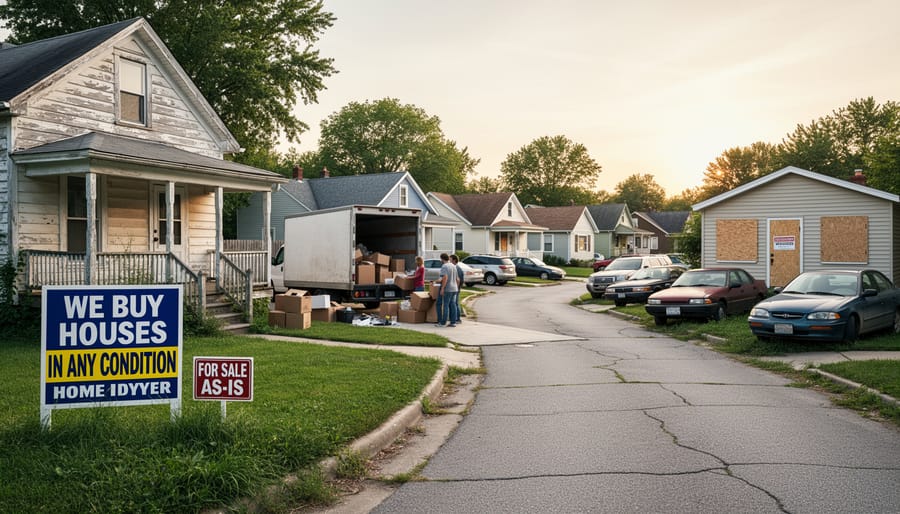
Market research data from 2026 reveals four primary seller segments that drive the any-condition buyer market, each with distinct motivations and urgency profiles. Property distress accounts for approximately 32% of sellers who accept these offers, typically facing foreclosure, tax liens, or insurmountable repair costs that exceed their financial capacity. These sellers prioritize speed and certainty over price maximization, often accepting offers 25-35% below market value to resolve pressing financial obligations.
Inherited property owners represent another significant segment, comprising roughly 28% of transactions with any-condition buyers. These sellers frequently live out of state, lack emotional attachment to the property, and want to avoid the time and expense of repairs, staging, and traditional marketing. Their motivation centers on simplicity and liquidity rather than maximizing every dollar of potential value.
| Seller Segment | Primary Motivation | Urgency Level | Market Share |
|---|---|---|---|
| Distressed Owners | Financial relief, avoid foreclosure | High | 32% |
| Inherited Property | Simplicity, avoid management burden | Medium | 28% |
| Relocating Homeowners | Quick sale, avoid dual payments | Medium-High | 23% |
| Elderly/Downsizing | Convenience, avoid repairs | Low-Medium | 17% |
Relocating homeowners make up 23% of the market, often facing job transfers or family situations requiring rapid relocation. They seek to avoid carrying two mortgages and prefer guaranteed closing dates over uncertain traditional sale timelines, particularly when their current property requires significant updates to compete in the retail market.
Elderly sellers and those downsizing account for the remaining 17%, motivated primarily by convenience and physical limitations that make managing repairs impractical. This demographic values the elimination of showings, open houses, and property maintenance during a potentially lengthy sales process.
Research consistently shows that time sensitivity drives seller decisions more than condition severity alone. Even sellers with moderately distressed properties choose any-condition buyers when life circumstances demand certainty and speed. The average seller in this market accepts a 20-30% discount in exchange for closing within 14-30 days, compared to 60-90 days for traditional sales requiring repairs and staging.
Competitive Landscape and Market Dynamics
Pricing Strategies and Offer Ranges
Market research reveals that cash buyers purchasing properties in any condition typically offer between 50% and 70% of after-repair value, though this range varies significantly based on property condition, local market dynamics, and buyer business models. Institutional buyers with efficient rehabilitation operations often bid at the higher end, while individual flippers requiring larger profit margins cluster toward the lower range.
Properties requiring cosmetic updates generally receive offers around 65-70% of ARV, while those needing structural repairs or major systems replacement see offers drop to 50-60% of ARV. Severe condition issues, particularly foundation problems or environmental contamination, can push offers below 50% as buyers factor in extended holding costs and specialized remediation expenses. Understanding this pricing vocabulary helps clarify how buyers structure their offers:
- ARV (After Repair Value)
- The estimated market value of a property after all necessary repairs and renovations are completed. Buyers use ARV as their baseline for calculating maximum offer amounts.
- MAO (Maximum Allowable Offer)
- The highest price a buyer can pay while still achieving their target profit margin, calculated as ARV minus repair costs and desired profit. This figure establishes the upper limit of negotiation.
- Wholesale Margin
- The profit percentage (typically 10-15%) that wholesale buyers build into offers when acquiring properties to resell quickly to other investors. These buyers prioritize transaction volume over per-deal profit.
- Flip Spread
- The total profit margin (usually 20-30%) that fix-and-flip investors target between purchase price plus renovation costs and final sale price. This accounts for holding costs, financing expenses, and business risk.
Competitive positioning tactics vary by market saturation. In high-competition markets, buyers may accept thinner margins (15-18% versus 25-30%) or offer faster closing timelines to win deals. Some buyers differentiate through flexible terms rather than price alone, including lease-back arrangements, partial cash offers with seller financing, or assumption of liens. Data from 2026 shows that in markets with multiple competing buyers, offer prices have compressed by 3-5 percentage points compared to markets with limited buyer presence, demonstrating how competition directly impacts seller outcomes.
Transaction Process and Closing Characteristics

Transactions with buyers who purchase properties in any condition diverge significantly from conventional residential real estate processes, primarily through accelerated timelines and reduced contingencies. While traditional home sales average 30 to 45 days from offer acceptance to closing, cash buyers typically complete transactions in seven to 14 days, with some institutional buyers closing in as few as five days when motivated by portfolio targets or market conditions.
The elimination of financing contingencies fundamentally alters transaction dynamics. Cash buyers remove mortgage approval delays and associated appraisal requirements, which historically account for approximately 12 percent of traditional sale failures. This streamlined approach reduces seller risk while enabling faster liquidity conversion, a critical factor for distressed sellers facing foreclosure timelines or financial deadlines.
Inspection practices differ markedly from traditional transactions. Rather than formal home inspections with negotiated repair credits, these buyers conduct abbreviated property assessments focused on structural integrity and cost verification rather than buyer protection. Many institutional buyers waive inspection contingencies entirely, having already incorporated estimated repair costs into their initial offers through proprietary valuation models. This approach mirrors principles of mission command in military operations, where decentralized decision-making authority and clear intent enable rapid execution without layered approval processes.
Closing procedures emphasize efficiency over complexity. These buyers typically use in-house title companies or preferred partners with expedited workflows, digital document execution platforms, and streamlined communication protocols. Sellers generally receive proof of funds within 24 hours of offer acceptance, establishing transaction credibility absent in financed purchases.
The simplified closing structure eliminates common traditional sale requirements including buyer financing approval, appraisal contingencies, and extended due diligence periods. This reduction in transaction friction points decreases average closing failure rates from the traditional market’s 8 to 10 percent to approximately 2 to 3 percent for cash transactions, according to 2026 settlement data.
Market Trends and Future Outlook
The ‘any condition’ buyer market continues to evolve in response to economic pressures, technological advances, and shifting consumer expectations. Current market data indicates measured growth in transaction volumes, with institutional buyers consolidating market share while individual investors adapt their strategies to maintain competitiveness.
Technology adoption represents the most significant operational shift affecting this market segment. Advanced property valuation platforms now incorporate satellite imagery, public records integration, and predictive analytics to assess repair costs with greater accuracy. Buyers who leverage these systems can make competitive offers faster while reducing evaluation errors that historically led to post-inspection price renegotiations. This technological sophistication has raised entry barriers for smaller operators who cannot justify the infrastructure investment required to compete on speed and precision.
Regulatory developments at state and municipal levels are introducing greater oversight of cash buyer transactions. Several jurisdictions have implemented mandatory disclosure requirements for buyers making ‘any condition’ offers, requiring clear explanation of how offers compare to market value and what services buyers provide. These regulations aim to protect vulnerable sellers from predatory practices while maintaining the legitimate function these buyers serve in the housing market. Compliance costs may consolidate the market further as smaller operations struggle with administrative burdens.
Market projections suggest continued growth in the institutional segment, particularly as economic uncertainty drives more distressed inventory. However, this growth may decelerate compared to the rapid expansion seen in previous years. Rising interest rates and construction costs have compressed profit margins on renovation projects, making buyers more selective about which properties they acquire even within the ‘any condition’ framework.
The competitive landscape is shifting toward service differentiation rather than price competition alone. Buyers now emphasize transparent processes, flexible closing timelines, and specialized expertise in specific property types or distress situations. This evolution reflects market maturation as sellers become more sophisticated in evaluating offers beyond the purchase price. Buyers who can demonstrate reliable execution and fair dealing are capturing greater market share, even when their initial offers fall slightly below competitors.
The landscape of buyers who purchase properties in any condition has evolved into a sophisticated, data-driven market that demands careful analysis from both sellers and real estate professionals. This segment operates on systematic evaluation frameworks rather than arbitrary assessments, using technology platforms and regional market intelligence to determine accurate pricing positions.
For sellers considering these buyers, understanding their operational criteria removes the mystery from what initially appears as unexplainable offers. These transactions reflect calculated assessments of repair costs, market positioning, and profit margins rather than attempts to exploit distressed situations. Properties with severe environmental contamination, extensive structural failures, or legal complications remain challenging even for specialized buyers, illustrating that “any condition” carries practical boundaries.
Real estate professionals benefit from recognizing how institutional consolidation, geographic concentration patterns, and competitive dynamics influence local market behavior. The distinction between corporate entities deploying algorithmic assessments and individual investors relying on personal expertise creates varied opportunity structures across regions.
External factors including interest rate cuts housing inventory levels, and regulatory frameworks will continue shaping this market segment. Professionals who base decisions on objective data rather than assumptions about buyer motivations position themselves to serve clients effectively, whether facilitating transactions with these specialized buyers or advising on alternative selling approaches when traditional sales remain viable.